
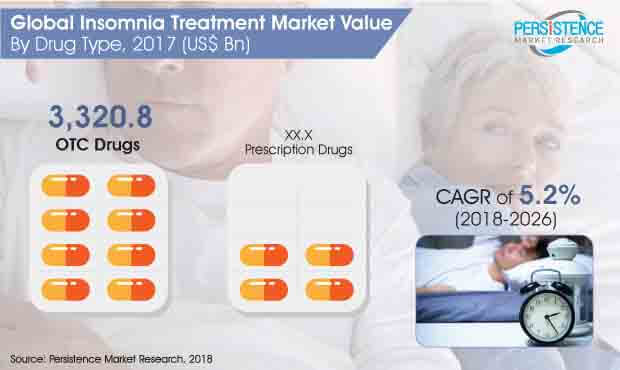
The insomnia treatment market is set to grow on a decent note, i.e. witnessing a CAGR of 5.2% between 2018 and 2026, reaching US$7.5 billion by the year 2018-2026. Workflows are becoming more streamlined due to increased connectivity and faster internet. This is an era of medical IoT, which continues to deploy wearable devices and various other embedded applications to meet healthcare needs. This would continue shortly as well.
Get a free sample copy of this report @ https://www.persistencemarketresearch.com/samples/23203
Technological innovations have revolutionized lifestyle, communication, business, travel, and healthcare. The health technology industry is continually improving ways to treat nerve-related medical conditions, along with significant understanding of the ramifications and downstream consequences. On the other hand, the pharmaceutical landscape has also transitioned and opened up to explore new scientific approaches and innovative technologies within its core therapeutic areas.
Company profiles:
- Sunovion Pharmaceuticals, Inc.
- Natrol, LLC
- GlaxoSmithKline Plc.
- Sanofi SA
- pfizer inc.
- Boehringer Ingelheim International GmbH
- malinckrodt
- PERNIX Therapeutics
- Takeda Pharmaceutical Company Limited
- Merck & Co Inc.
- Others.
New Pharmaceutical Innovations to Address Key Sleep Medication Concerns
At the Associated Professional Sleep Societies 32nd Annual Meeting (SLEEP 2018), Eisai Co., Ltd. and Purdue Pharma LP showed positive results from clinical trials of lemborexant, which is currently being studied for the potential treatment of multiple sleep disorders. sleep, especially insomnia. Examining lemborexant for sleep onset, sleep maintenance, and return-to-sleep latency, it showed favorable results in terms of postural instability and residual effect compared to placebo and zolpidem (Ambien).
Methodology Request @ https://www.persistencemarketresearch.com/methodology/23203
Several pharmaceutical companies are establishing new advances in the segment of sleep medications to meet the specific and unmet needs of patients with insomnia. Such innovations are expected to help improve sleep at night and also allow patients to function properly upon awakening, which has been a growing concern among older adults.
Smart glasses, wearable tracking devices and more are here to stay
Multiple companies in the market are working on wearable insomnia treatment devices , one of which is smart glasses; patients can now wear a pair of smart glasses to sleep. Recent studies indicate that smart glasses use light and sound stimuli to trigger specific patterns in the brain that would eventually induce sleep. The light emitted from the glasses has a certain wavelength that stimulates the hypothalamus gland within the brain. This leads to a controlled secretion of melatonin, a hormone responsible for sleep patterns.
In addition, FDA-approved home and wearable tracking devices that monitor brain activity, leg movement, and respiration are becoming more common in the field of sleep research. Another ‘chemical-free’ alternative is telehealth, which involves various ways of communicating with patients about their sleep health. Clinicians and researchers are likely to focus on telehealth in the near future.
In other research, scientists have discovered that certain cells in the brains of mice express a gene called Lhx6, which promotes sleep. When activated, the Lhx6 gene induces sleep in mice; and woke up the mice when turned off. In addition, a similar gene is also found in the human hypothalamus gland, and is expected to be potentially studied for sleep regulation. Compounds with properties similar to those of the Lhx6 gene are most likely to be incorporated with drugs for insomnia, to improve efficacy.
New drug formulations will continue to be a key strategy among pharmaceutical industries
A recent study by Persistence Market Research indicates that over-the-counter medications bring the highest revenue share in the global insomnia treatment market, due to growing preference among insomnia patients. In order to make insomnia treatment drugs more effective and occupy a larger share of revenue in the global market, the development of new drug formulations is anticipated to remain a key strategy among major pharmaceutical industries.
In addition to expanding the geriatric population, some of the most common concerns, such as dependency, addiction and residual symptoms, will further compel the requirement to transform the insomnia treatment market during the projection period, 2018-2026. The global market for insomnia treatment is expected to be valued at around US$7.5 billion by the end of 2026, expanding steadily at a CAGR of 5.2% during 2018-2026.
While North America has a substantial revenue share of the global insomnia treatment market, retail pharmacies are the most preferred for buying insomnia treatment medications.
Access the full report @ https://www.persistencemarketresearch.com/checkout/23203
About us: persistence market research
Contact Us:
Persistence Market Research
Address – 305 Broadway, 7th Floor, New York City, NY 10007 United States
US Phone – +1-646-568-7751
US-Canada Toll Free: +1 800-961 -0353
Sales – sales@persistencemarketresearch.com
